

Sodium Borohydride Reduction Of Benzil
Stereochemical Assay of Benzil Reduction
Abstruse
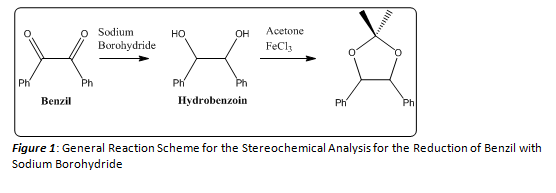
This series of reactions ( Figure 1 ) were carried out outset using benzil and sodium borohydride to form the hydrobenzoin production, then the hydrobenzoin product was combined with anhydrous acetone and iron trichloride to form the production (4S-5R)-2,2-dimethyl-4,v-diphenyl-1,3-dioxolane. A melting betoken range was acquired for the hydrobenzoin product, while a 1H NMR was nerveless to determine if the intended final production was formed and moreover the stereochemical backdrop of the final product. This final product was formed and then as to more easily identify the stereochemistry of the hydrobenzoin product. A elementary iH NMR of the hydrobenzoin product could not be used to distinguish between dissimilar stereochemical outcomes, therefore the formation of the acetal derivative assists in distinguishing which stereochemical compound that was formed. The melting point range of the hydrobenzoin product was establish to be 136.1– 136.5 OC (Lit.one 137 – 139 OC). The overall per centum yield of this serial of reactions was calculated to exist 44.45%, while the percent yield for the formation of the hydrobenzoin was calculated to be lx.62%. The overall reaction was relatively simple and resulted in the formation of the stereospecific product.
Introduction
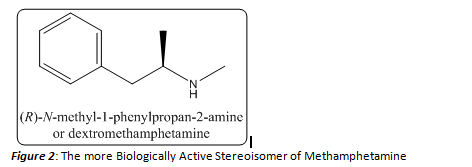
Stereospecificity is the property of a sure reaction mechanism the results in the formation of detail stereoisomeric products. A stereospecific machinery explicitly defines the stereochemical outcome given a specific reactant. Given a single, stereoisomerically pure starting material, or a mechanism in which a certain stereoisomer is energetically favored, the stereospecific will result in the germination of a single stereoisomer. Stereospecific products are of import when a certain stereoisomer is able to be utilized while the others are not. In applications like pharmaceuticals and various amino acids used in biological systems simply apply 1 of the stereoisomers. Stereospecific reactions cutting down on the fourth dimension and possible cost associated with separating the stereoisomeric forms in a reaction mixture. Many drug manufacturing processes utilize stereospecific reagents in order to increment the overall yield and to decrease overall toll of the manufacturing procedure. One interesting reaction mechanism is the stereospecific reductive amination of phenyl-2-propanone to form the more biologically agile dextromethamphetamine, or as information technology is usually known, crystal methamphetamine (Figure 2). There are as well other various applications of stereospecific products including scents and flavoring 3 .
In this experiment, the reduction of Benzil using sodium borohydride was run in order to determine whether the reaction was indeed stereospecific. On first glance, the reduction of benzyl using sodium borohydride could result in the formation of three different stereochemical products as shown in Figure 3.
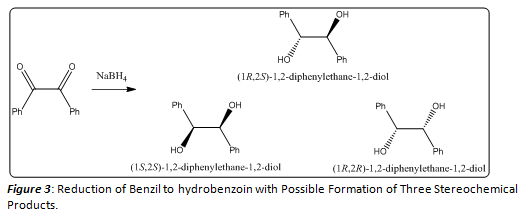
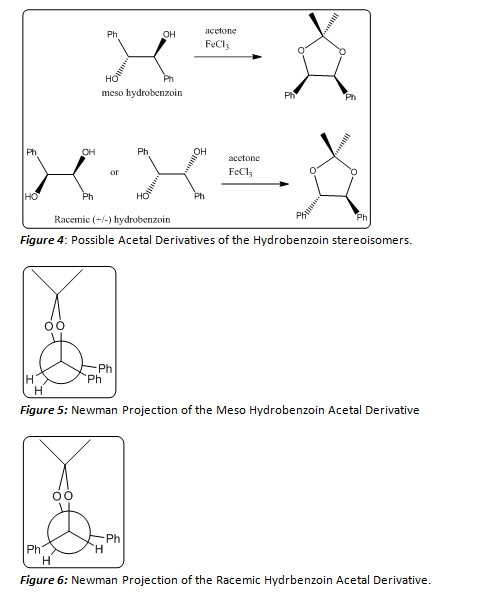
These three stereoisomers, the meso compound or (1R, 2S)-ane,2-diphenylethane-1,2-diol, or a racemic mixture of (+/-)-one,ii-diphenylethane-1,ii-diol, provide well-nigh identical iH NMRs, then the stereochemistry of these products cannot exist fully adamant past this method. In order to accurately determine the stereochemistry of the production or products formed, a derivative of the hydrobenzoin, with a distinct NMR must be made. In this example, the formation of an acetal of the hydrobenzoin production (Figure 4) volition assistance in determining the stereochemistry of the product. The 2 Newman projections in (Figures 5 and 6) depict the stereochemical outcomes with respect to the ethane backbone within the molecule. By forming this acetal derivative of the hydrobenzoin product, the stereochemistry can be determined using a simple 1H NMR. If the meso hydrobenzoin product was formed, the resulting acetal derivative would show two distinct methyl groups in its 1H NMR spectrum. The methyl grouping that resides on the same side of the molecule as the two phenyl groups would be deshielded, resulting in a higher chemical shift for those protons, while the other methyl group would non exist deshielded and would have a lower chemical shift. If the (+/-) hydrobenzoin products were formed, the resulting acetal derivative would show no stardom between the ii methyl groups. They would both exhibit equal chemical shifts. This simple spectroscopy technique can allow scientists to further investigate the mechanistic principles that govern this reaction. In general, chemists must utilize like chemical reactions in gild to ameliorate sympathize the mechanisms involved in diverse processes. Today, cutting border inquiry is being done to better explore the mechanistic pathways of numerous chemic reactions.
Results and Word
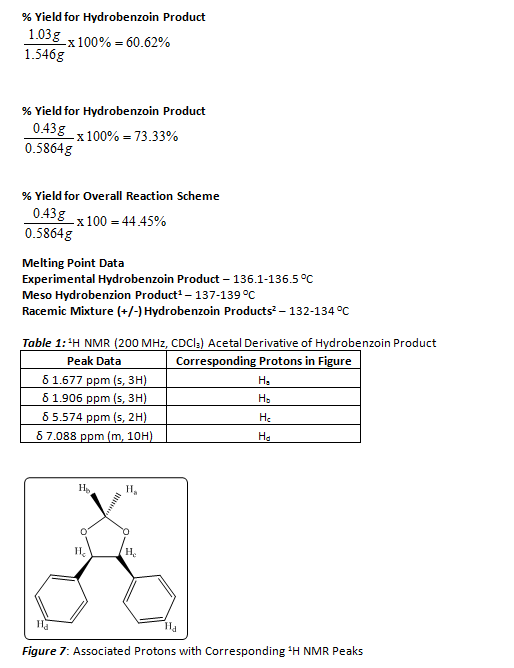
Once the hydrobenzoin product was collected and dried, a percent yield and melting betoken range was obtained. The percent yield was constitute to exist 60.62%, and the melting signal range was found to be 136.1 -136.5 OC. By finding this melting point information technology could exist inferred that the meso hydrobenzoin product had been formed, just a 1H NMR of the production could provide more prove of the formation of this specific product. Since the oneH NMR of all of the stereoisomers of hydrobenzoin are about indentical, an acetal derivative of the product was formed (Figure 4).
The acetal derivative of the hydrobenzoin product formed an oil, and a percent yield and 1H NMR of this production was able to be acquired. The percent yield was found to be 73.33%. And the oneH NMR (200 MHz, CDCl3), Tabular array 1, was utilized to narrate this acetal derivative of the hydrobenzoin. In that location were a few solvent peaks that showed up on the NMR spectrum, but could be ruled out every bit constituents of the petroleum ether used to hot filter the product in the concluding step of the lab procedure. In that location are four main peaks that correspond to the production formed. (Figure 7) The peaks at δ 1.677 and 1.906 ppm correspond to the two methyl groups fastened to the acetal. The singlet at δ 5.574 ppm corresponded to the protons located on the ethane courage of the product, and the multiplet at δ seven.088 ppm corresponded to the aromatic protons of the two phenyl rings. As noted before, depending on the stereoisomer of the hydrobenzoin, the acetal derivative could form two singled-out stereoisomers (Figure 4). In order to determine which stereoisomer of the hydrobenzoin was formed, the Newman projections of both acetal derivatives must exist compared to the 1H NMR. If the production in Figure half-dozen had been formed the methyl grouping peaks in the 1H NMR would have been indistinguishable, and would have resulted in a singlet that integrated for six protons. As seen in Table 1, there is no singlet that corresponds to vi protons. Instead, one of the methyl groups has a college chemical shift than the other. This can be explained by examining Figure five. By forming the acetal derivative with the two phenyl rings on the same side, the methyl group that resides on that side of the molecule is deshielded, and therefore has a higher chemical shift than the other methyl group which does non encounter the deshielding effects of the phenyl rings. Since the meso hydrobenzoin product was the merely chemical compound that could lead to the formation of this acetal derivative, the reduction of the benzyl to hydrobenzoin using sodium borohydride must exist a stereospecific reaction mechanism. Below a mechanism that is consistent with this determination is shown (Figure 8).
After forming the meso hydrobenzoin product, the acetal derivative was formed. The reaction mechanism is shown in Figure 9. In this part of the experiment, all glassware needed to be dry in order to forestall the germination of either a hydrate, or the reversal of the germination of the acetal. Fe trichloride acts equally a lewis acid in this mechanism allowing for the nucleophilic addition of the diol. If we had used an acid goad such equally hydrochloric, which is an aqueous solution, h2o would have been introduced to the reaction mixture. And acrid catalyzed hydrolysis of the acetal product is possible, as stated before. Finally, the reaction mixture was diluted with 10% potassium bicarbonate. This pace is used to neutralize any acid in solution, because the acetal that is formed is stable to base hydrolysis.
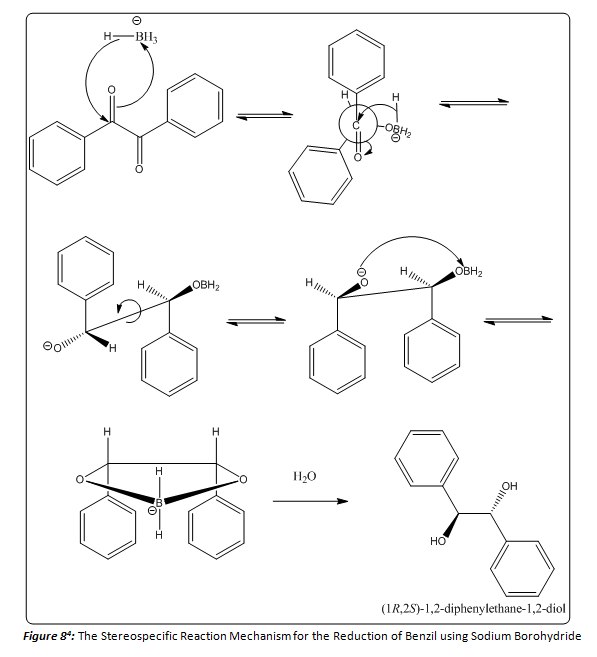
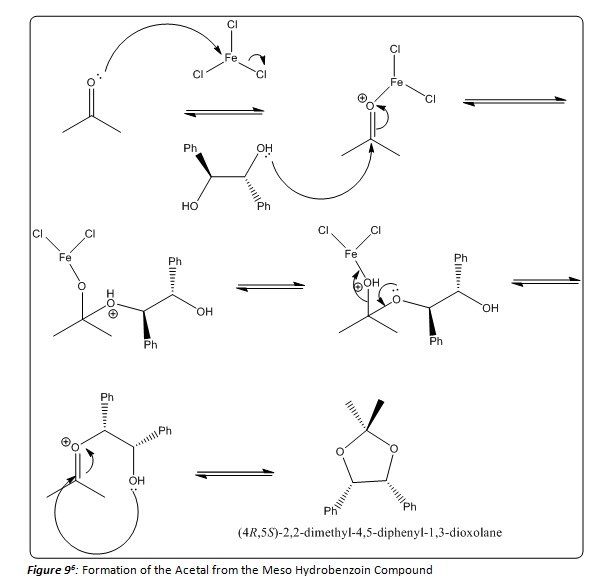
By analyzing the information in the 1H NMR, it was possible to decide that (4S-5R)-ii,2-dimethyl-four,v-diphenyl-one,3-dioxolane had been formed, which provides evidence that the meso hydrobenzoin product had been formed in the starting time step. With this information it is possible to say that the reduction of benzyl to hydrobenzoin using sodium borohydride is diastereoselective and likewise stereospecific. The reaction yields but the meso hydrobenzoin chemical compound.
Conclusion
Overall, this experiment was a success. In order to heighten the efficiency of the start reaction, the fourth dimension over which the sodium borohydride was added and the time over which the reaction mixture was allowed to stir could be increased in order to ensure that more than of the sodium borohydride had reacted with the benzil. Since the stereochemistry of the hydrobenzoin production could non be inferred from its oneH NMR, an acetal derivative of the product was fabricated. This formed an oil which was able to exist run in the NMR, and a useful iH NMR spectrum was acquired. The NMR spectrum led to the determination that the (4S-5R)-ii,two-dimethyl-4,5-diphenyl-i,3-dioxolane, acetal product had been formed. This conclusion provided prove that the meso hydrobenzoin product had been formed exclusively in the showtime step of the experiment. The proton NMR along with the melting betoken range acquired, 136.1– 136.5 OC (Lit.ane 137 – 139 OC), for the hydrobenzoin compound helped to lead to this determination. The overall reaction was relatively unproblematic and resulted in the germination of a stereoisomeric product that could exist studied using NMR.
Experimental
Starting materials were obtained from the instructor and used without further purification. 1H NMR spectrum obtained on a 200 mHz NMR in CDCl3.
(1R, 2S)-one,two-diphenylethane-1,2-diol
Benzil (1.517 g, 7.22 mmol) was added to a 50 mL round bottom flask. To this, a stirbar and 20 mL ethanol were added. The solution was heated gently and stirred until all of the Benzil had dissolved in the ethanol. So, over the form of fifteen minutes, sodium borohydride (0.300 yard, 7.93 mmol) was added to this solution. This reaction mixture was then left to stir for another fifteen minutes. Then 10-20 mL of water was added drib-wise to the reaction mixture over the grade of fifteen minutes. This was then left to stir for an additional 15 minutes. Then finally iv-five drops of HCl were added to the reaction mixture until a white precipitate formed. Later germination of the precipitate, the reaction mixture was left to stir for 15 minutes. Finally, 15 mL of water ice cold h2o was added to the reaction mixture. The reaction mixture was then filtered and the white crystalline product was nerveless and dried. This reaction resulted in the formation of i.03 grand of product. Mp 136.one-136.5 OC (Lit.1 137-139 OC.
(4S-5R)-2,2-dimethyl-4,5-diphenyl-i,3-dioxolane
Prior to beginning the experiment, all glassware was placed in oven to ensure they were dry before apply. Then, the nerveless hydrobenzoin product (0.5 g, 2.33 mmol) and ferric chloride (150 mg, 0.92 mmol) were added with a stirbar to a 25 mL roundbottom flask. Then, anhydrous acetone (15 mL, 0.204 mol) was added to the reaction mixture and heated to boiling under reflux for 20 minutes. Then, the solution was cooled and poured into a separatory funnel containing v mL of 10% aqueous potassium carbonate. This was then swirled gently before calculation 25 mL of h2o. The crude product was extracted from the aqueous mixture with 2 X ten mL portions of dichloromethane. The collected organic extracts were then combined and washed with 10 mL of water. The organic layer was then dried with sodium sulfate. Them the dichloromethane was decanted from the drying agent into a small round bottom flask. The solvent was then removed to go out an oily residuum. This crude oily balance was then dissolved in 10 mL of boiling petroleum ether (30-lx OC) and quickly hot filtered through a Hirsch funnel into a small sidearm flask to remove any insoluble unreacted diol. Air was continuously pulled through the sidearm flask until the petroleum ether evaporated and an oil was left behind. The sidearm flask was weighed with production, then a 1H NMR was collected. Finally the sidearm flask was cleaned and dried and weighed. This reaction resulted in the formation of 0.43 k product. 1H NMR (200MHz, CDClthree) δ ane.677 ppm (s, 3H), 1.906 ppm (due south, 3H), 5.574 ppm (s, 2H), 7.088 ppm (m, 10 H).
Procedures taken from Dr. Burlingham6. "Stereochemical Analysis of Benzil Reduction" CHEM C 344.
References
i) Meso-hydrobenzoin; MSDS No.294535 [Online]; Sigma Aldrich: May 18, 2012. http://www.sigmaaldrich.com/itemize/product/aldrich/294535 (Accessed 3/2/2014).
2) Hydrobenzoin (racemic); CAS No. 655-48-ane [Online]; ChemDoor: 2011. http://www.chemdoor.com/cas/655-48-1.html (Access iii/two/2014).
3) Leitereg, Theodore J. et al. Chemical and sensory information supporting the deviation between the odors of the enantiomeric carvones. Chem. Rev. [Online] 1971, J. Agric. Food Chem., 1971, 19 (4), pp 785–787. http://pubs.acs.org/doi/abs/x.1021/jf60176a035 (accessed November 25, 2012).
four) Todd, D. J. Chem. Educ. 1979, 56 540; Rowland, A.T. J. Chem Educ. 1983, 60, 1084. Cram, D.J.; Kopecky, Grand.R. J. Am. Chem. Soc. 1959, 81, 2748.
5) Klein, D. Organic Chemistry John Wiley & Sons, Inc.; Hoboken, New Jersey 2012
vi) Burlingham, Ben. Stereochemical Analysis of Benzil Reduction. Chemistry C344. Indiana Academy. Leap 2014.

Sodium Borohydride Reduction Of Benzil,
Source: https://www.odinity.com/stereochemical-analysis-benzil-reduction/
Posted by: newkirkseleas.blogspot.com
0 Response to "Sodium Borohydride Reduction Of Benzil"
Post a Comment