

How Big Do Dumbo Rats Get
Facts Near Rats
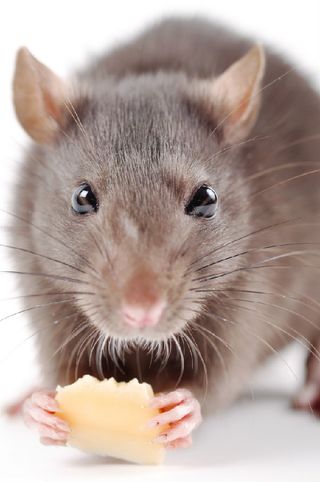
Rats are thin-tailed, medium-size rodents that originated in Asia and Australia but are now establish all over the world. "True rats" are members of the genusRattus, but other rodent genera are likewise referred to as rats and share many of the same characteristics. Rats differentiate from mice past being larger, with longer, thinner bodies and long legs.
Size
According to the Integrated Taxonomic Information System (ITIS) at that place are more threescore species of rat, which means they come in all sizes. They are typically v inches (12 centimeters), or longer, according to Encyclopedia Britannica. The largest species is the Bosavi woolly rat, which was discovered in 2009 in the rainforest of Papua New Republic of guinea (and doesn't take a scientific name all the same). Information technology is about the size of a cat — 32.2 inches (82 cm) from nose to tail and weighs effectually 3.3 lbs. (1.5 kilograms), co-ordinate to CNN. One of the smallest rats is Osgood's Vietnamese rat. It is typically five to seven inches (12 to 17 cm) long.
Co-ordinate to the Australian Broadcasting Corp., male rats are called bucks; females are does. Infants are called pups or kittens. A group of rats is chosen a mischief.
Habitat
Rats are found all over the world. For example, the rice-field rat is constitute in Southeast Asia, the Australian swamp rat is constitute in Eastern Australia, and the Kingdom of norway rat, also called brown rats, is found on every continent of the world except Antarctica, co-ordinate to the Fauna Diversity Web at the University of Michigan.
The dark-brown and the house rat are the well-nigh common rats in the world considering they have taken boats to every country over the by few centuries. Business firm rats typically like warmer climates, while brown rats alive in temperate climates. They typically alive anywhere humans live. Many rat species also live in copse.
Habits
Overall, rats live to provender and mate. Nigh rats are nocturnal, though the brown rat is often awake day or night.
Rats commonly stick together in groups called packs. New packs are formed when a male and female go off on their own and nest in an area that doesn't already contain a pack. Dark-brown rats are usually led by the largest male in the pack. Other rats may have several ascendant males or females in a pack.
Diet
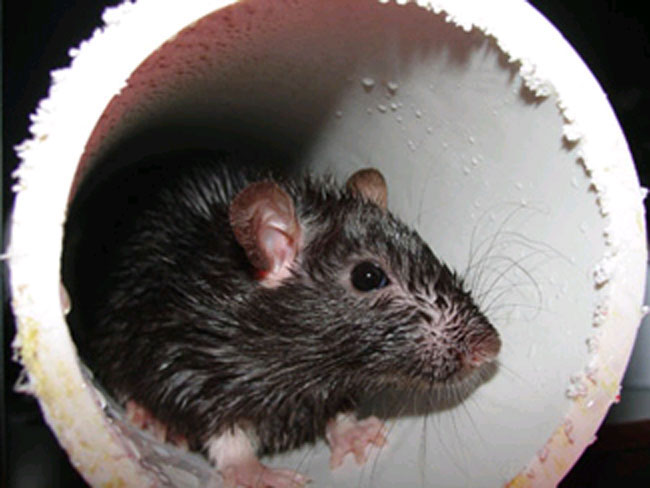
Rats are omnivores, but many prefer meat when they tin can become it. House and brownish rats usually utilize humans for their primary food source. They will scavenge through trash or eat whatsoever food that is left unprotected.
Rats have besides been known to swallow grain or kill insects, h2o creatures such as snails, fish and mussels, small-scale birds, mammals and reptiles for food. Other rats, such as the Sulawesi white-tailed rat and Hoffman'due south rat, adopt vegetarian off-white such every bit seed and fruits, according to Encyclopedia Britannica.
Offspring
Before their offspring are born, rats build nests from any material that can be foraged from the area, including branches, grass, trash and newspaper. These nests are usually built in crevices, in rotting trees or in buildings.
Rats, by and large, are baby-making machines. Female rats can mate effectually 500 times in a six-hour period and brown rats can produce up to 2,000 offspring in a twelvemonth, co-ordinate to Notice Magazine. Brown rats can accept upwardly to 22 young at once, though eight or nine is more the average. Tropical rats tend to simply accept one to 6 babies at in one case.
Afterwards a gestation period of 21 to 26 days, babies that weigh only effectually 6 to 8 grams (.21 to .28 ounces) are born, according to the American Fancy Rat and Mouse Association. Past the age of 3 months, the brownish rat is ready to reproduce. Rats typically live around 2 or three years. Most house rats — 91 to 97 percent — dice inside their showtime year of life, according to the University of Michigan.
Classification/taxonomy
Here is the taxonomy of rats co-ordinate to ITIS:
- Kingdom: Animalia
- Subkingdom: Bilateria
- Infrakingdom: Deuterostomia
- Phylum: Chordata
- Subphylum: Vertebrata
- Infraphylum: Gnathostomata
- Superclass: Tetrapoda
- Grade: Mammalia
- Subclass: Theria
- Infraclass: Eutheria
- Order: Rodentia
- Suborder: Myomorpha
- Superfamily: Muroidea
- Family: Muridae
- Subfamily: Murinae
- Genus:Rattus
Species include:
- Rattus argentiventer— Rice-field rat
- Rattus hoffmanni— Hoffmann'south Sulawesi rat
- Rattus lutreolus— Australian swamp rat
- Rattus norvegicus— Norway rat, or brown rat
- Rattus osgoodi— Osgood'southward Vietnamese rat
- Rattus rattus— House rat, or black rat
- Rattus xanthurus— Northeastern Xanthurus rat, or Sulawesi white-tailed rat
Conservation status
The International Union for Conservation of Nature (IUCN) lists xvi rat species on its Cerise List of Threatened Species. They are considered threatened with extinction due to loss of habitat and decreasing populations.
Nearly Threatened
- Rattus elaphinus (Sula Archipelago rat)
- Rattus feliceus (Spiny Seram Isle rat)
- Rattus jobiensis (Yapen rat)
Vulnerable
- Rattus hoogerwerfi (Hoogerwerf's Sumatran rat)
- Rattus palmarum (Zelebor's Nicobar rat)
- Rattus richardsoni (Glacier rat)
- Rattus satarae (Sahyadris forest rat)
- Rattus stoicus (Andaman rat)
- Rattus xanthurus (Northeastern Xanthurus rat)
Endangered
- Rattus burrus (Miller's Nicobar rat)
- Rattus hainaldi (Hainald's Flores Island rat)
- Rattus lugens (Mentawai Archipelago rat)
- Rattus montanus (Sri Lankan mountain rat)
- Rattus ranjiniae (Ranjini's field rat)
- Rattus simalurensis (Simalur Archipelago rat)
- Rattus vandeuseni (Van Deusen's rat)
Other facts
Brownish and house rats have made a number of mammal, bird and reptile species extinct, especially on oceanic islands, according to Encyclopedia Britannica. They have besides spread of diseases among humans, including bubonic plague.
Rats aren't all bad, though. Brown rats are used in laboratories for research. In fact, co-ordinate to the Foundation for Biomedical Research, 95 percent of all lab animals are mice and rats.
A rat's forepart teeth grow 4.5 to five.5 in (11 to xiv cm) each year, according to Find Magazine.
Boosted resources
- Notice Magazine: twenty Things You Didn't Know Nigh Rats
- Net Middle for Wild fauna Damage and Management: Kingdom of norway Rats
- U.s.a. Fish and Wildlife Service: Facts Near Rats

How Big Do Dumbo Rats Get,
Source: https://www.livescience.com/52342-rats.html
Posted by: newkirkseleas.blogspot.com
0 Response to "How Big Do Dumbo Rats Get"
Post a Comment